Showing posts with label Tonga. Show all posts

Thursday, May 10, 2012

USA and Canada close to joining Pacific Nations Cup


Japan celebrate winning 2011 Pacific Nations Cup
As reported back in January, the Tier Two rugby nations are not overly happy with the global rugby order and are seeking significant changes to have a solid and competitive international program. The President of the Georgia Rugby Union, Gia Niijharadze had made reference to a meeting to involve rugby´s second tier nations - Canada, Fiji, Georgia, Japan, Romania, Russia, Samoa, Tonga and the United States of America with the objective being to establish a competition involving these sides and for the competition to start in 2013. The meeting indeed was held, taking place in las Vegas, Nevada in February.  

The chances of such a competition getting the green light from the IRB remain unknown but there is no doubt that chances will be made, and in fact, some already have been. The CEO of USA Rugby, Nigel Melville outlined the changes for the USA mens team on his personal website this past weekend. It followed a weekend of negotiations with union members representing the Pacific Islands, Japan and the IRB and had the specific purpose of attempting to create a new structure for the Pacific Nations Cup for the years of 2013, 2014 and 2015. The Pacific Nations Cup started in 2006, replacing the Pacific Tri Nations which featured Fiji, Samoa and Tonga. Japan entered in 2006 as did the Junior All Blacks and Australia A entered in 2007. Neither of the A teams from Oceania´s Tier One sides compete any longer in the competition due to economic cut-backs but this is a good thing for Second Tier rugby as the void left by these teams would be much be utilized by a test playing team such as the USA Eagles and Canada.

Melville pointed out that the serious lack of regular international competition of real meaning is the biggest challenge to USA Rugby. Without changes being made it is a highly complicated road to see the USA Eagles become more competitive. He contends that the USA want to play against Tier One teams but its not easy to secure matches given the clear preference of playing against other Tier One sides due to the higher commercial value on offer. That being said, Melville also acknowledges the comparable advantage of the USA touring Europe to face Tier Two sides rather than Tier One sides. The November 2010 tour being such an example when the USA played Georgia and Portugal. Facing these teams as well as Romania, Russia and Spain is certainly the right direction for November tours. 

The USA have the international windows of June and November to field its strongest players and this is the focus with Melville looking to maximize these slots to the advantage of the USA Eagles. With neighbours, Canada being in precisely the same situation and the changes that have seen the Churchill Cup axed will be felt next month with both Canada and the USA hosting Georgia and Italy as well as playing each other. This is an ideal fixture list for both teams and it will be replicated in 2013 and 2014 with Ireland and Scotland to tour North America.

The discussions surrounding North American participation in the Pacific Nations Cup have taken the direction of Europe. While the first tier play in the Six Nations, the second play in the European Nations Cup, a FIRA tournament involving six teams taking place at the same time as the Six Nations, but spread of two years to have home and away matches. Melville pointed out that such a model looms as the way forward for the Second Tier outside of Europe. As such, Canada and the USA would like to be included in an expanded Pacific Nations Cup to play with matches against Fiji, Japan Samoa and Tonga serving the interests of not only the North Americans but also the four existing sides.

To ensure the competition can be as successful as it ought to be it will take place in June and this is where the biggest challenge lies for the teams. The proposal that the IRB is currently evaluating is for the USA and Canada to have one home test per year against a Tier One side (with Ireland and Scotland already locked in for 2013 and 2014) in June and matches against Canada plus the four Pacific Nations Cup teams. November tours will not be altered with matches to be played against teams from the European Nations Cup.

As such a sample schedule for 2013 could well be similar to the following:

Saturday June 8 USA vs Japan (Pacific Nations Cup)
Saturday June 15 USA vs Ireland
Friday June 21 USA vs Tonga (Pacific Nations Cup)
Wednesday June 26 Fiji vs USA (Pacific Nations Cup)
Sunday June 30 Samoa vs USA (Pacific Nations Cup)

Saturday July 13 USA vs Canada (Pacific Nations Cup + World Cup Qualifier)
Saturday July 20 Canada vs USA (Pacific Nations Cup + World Cup Qualifier)

Saturday November 9  Spain vs USA
Saturday November 16 Romania vs USA
Saturday November 23 Russia vs USA
Saturday November 30 Georgia vs USA

Based on: Nigel Melville

Thursday, April 5, 2012

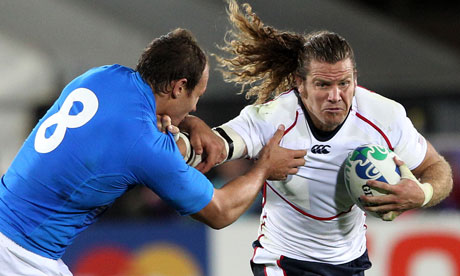
USA vs Tonga - Rugby World Cup 2007


Four days after facing England and giving the 2003 World Champions a good match, the United States of America was playing its second match of the tournament. The opponent was the Pacific Island nation of Tonga and it was the first match for the men in red. The USA had given England a good match in preventing a strong team from scoring four tries which meant the Tier One side missed out on earning a bonus point. England had no such issues vs its two other Tier Two opponents - Samoa and Tonga.

The clash in Montpellier between the USA and Tonga was to be a tournament defining match for both sides. Leading into the tournament the only team considered capable of giving either England or South Africa a good match was Samoa. What transpired proved that the predictions of many to be off the mark. Tonga were the biggest surprize in giving both Tier One nations hard matches. Tonga came very close to defeating South Africa and in the first half vs England were indeed looking strong. Samoa was thrashed by the Springboks in its first match, conceeding over 50 points and, despite improvement vs England, the men in blue were well beaten. Tonga, before facing England and South Africa, had already defeated Samoa and the USA.

The win over the USA was well documented by USA rugby officials as being a hard pill to swallow. The North Americans, to this day, believe it should have been a USA victory. The major reason why it was not is the start of the match with the USA letting in a try, something that proved fatal. Had the 2011 team been together and had the same experience the liklihood is that the Eagles would have been victorious over Tonga. The match was a strong learning curve and proved very useful for the USA in its preperation for Rugby World Cup 2011. The teams leaking of tries would not repeat itself in 2011 and the USA was a much better team as Ireland failed to score four tries and Italy´s bonus point came from a penalty try. The win over Russia was a defining moment in showing the maturity of the North Americans. It underlined the progress that had been made as a team and, especially in terms of preperation.

Four years earlier, the end of the match between England and the USA was ruined by a dangerous tackle by USA center, Paul Emerick. The tackle on Olly Barclay ended his World Cup as he was suspended. At the time Emerick was the USA´s most decorated player. He was a professional based in Europe and had been for several years. He was surrounded by USA based players, many have since gone to to pick up long term professional contracts for leading teams. The young fullback Chris Wyles, for instance, won the Aviva Premiership with Saracens in 2011 and Todd Clever is a Japanese Champion with Suntory Sungoliath. Other names to emerge include Lou Stanfill and Taku Ngwenya.

Despite the result not bing in the favor of the North Americans, the 2007 clash vs Tonga in Montpellier was nonetheless a great game of rugby. It came at a time when Tier One sides were pushing for a reduction in World Cup participants from 20 teams to 16. France 2007 showed that this argument was a weak one as Tier Two games not only gave Tier One teams good games but also had great games amongst themselves and did so with strong crowds. Curiously the only two matches which were not either sold outor close to it were Tonga´s matches vs the USA and Samoa in Montpellier. 


Tuesday, March 27, 2012

Wales vs Canada 1993

The recently crowned Grand Slam Champions of Europe, Wales were one team that was defeated at the hands of Canada in the 1990´s. Canadian rugby was on a high in the latter stages of the days of amateurism and backed up its appearance at the Quarter Finals stage of Rugby World Cup 1991 with some impressive results in the following years. In Rugby World Cup 1991 Canada had impressed in defeating Fiji and Romania and gave France a good match before losing. It was, nevertheless, enough to advance and Canada faced New Zealand in the Quarter Finals, giving the All Blacks a good run for their money. Rugby purists the world over are well aware of Canada´s appearance at the Quarter Finals stage and it is used as a marker to show that Canada is a proud rugby country that has achieved on the greatest stage of them all. 

Al Charron, RWC 2003 Captain
Canada´s biggest accomplishments, possibly of all time, were not in 1991, however. Rather, the year 1993 is one which to this day has been Canada´s finest hour. Canada hosted England while the Lions were touring New Zealand and as such, the RFU requested that the match not be termed an international and had England play under the name of England XV. It was, in effect, a strategy utilized to make it a win-win situation for England. Should England lose they could blame it on the Lions and claim it was just a training match. A win, in contrast, would be a way of saying England´s depth is strong and formidable. The cover that this provided worked out in England´s favor as Canada´s 15-12 win at Burnaby Lake has gone down in history as being a non-international. Latter that year, Canada were not denied a famous win on a techinicality, however as Wales defeated Wales 26-24 in Cardiff thanks to a late try to Al Charron to claim what, to this day, remains Canada´s greatest triumph. The match took place at the venue that has since been upgraded and renamed as the Millenium Stadium. Not only did Canada win in Wales but the home side was unable to score a try with Neil Jenkins´ boot being responsible for all of the Welsh points. 

Gareth Rees, RWC 1995 / 1999 Captain
The following year, Canada continued to impress with the North Americans completing an 18-16 home victory in Nepean over France with IRB Hall of Famer, Gareth Rees kicking the Canadians to victory. During this period, Canada was also significantly better than its North American counterpart, the USA with Canada regularly winning the matches and doing so by comfortable margins. Canada was also too strong for Japan and completed a good 22-10 win over Fiji in Nadi in 1995. Being drawn with both Australia and South Africa at Rugby World Cup 1995 meant Canada´s chances of advancing to the Quarter Finals were extremely difficult and this proved to be the reality despite Canada giving both teams strong matches. From there things became tougher and tougher for Canada as the advent of professional rugby lifted the level of all teams who exposed their players to professionalism. Canada missed the boat and it has proven to have held back the development of the country´s national team. Fiji, with players involved in Super Rugby and elsewhere completed a 38-22 win over Canada during Rugby World Cup 1999. Canada then went on to  crush Namibia 72-11. Had Canada won vs Fiji it would have advanced in the tournament. 

Tuesday, March 20, 2012

IRB World Rankings June Implications


Canada celebrate beating Tonga. Could Canada make the Top Ten?
Following the completion of Europe´s premier international competition, the Six Nations the IRB World Rankings of its participants tell a tale of two cities. There is a clear split between the top four and the bottom two. Champions Wales were undefeated and deserved the title but the teams wins over England and France were Ireland were by small margins and all could have been loses. Results against Italy and Scotland were clearer with bigger wins not only from Wales but from the other three teams. It is a continuation of a long term trend in which Scotland have been falling behind while Ireland and Wales have been eliminating the gap between themselves and that of England and Scotland. Italy, in contrast to Scotland, have been improving and the evidence on the international stage as well as within Italian rugby seems to underline the progress of the sport in the country. Scotland, like Italy, are seemingly now a far different prospect at home than in away matches. While the other four are able to perform well home and away.

Could the USA topple Italy in 2012?
The IRB World Rankings have neither Italy nor Scotland in the World´s Top Ten. Both teams are in fact ranked much closer to Canada than they are to Argentina. Canada ranked 13th in the world with Italy and Scotland in 11th and 12th. The points difference sees Canada less than one point behind Scotland and less than two behind Italy. Scotland are more than six points behind Argentina. The European team ranked closed to both Italy and Scotland (besides eachother) is not a Six Nations participant, but rather, Georgia. Similar to Argentina entering The Rugby Championship, Georgia needs to be integrated into the Six Nations. One thing that the current shape of the World Rankings does show is that the June 2012 tours are set up well with Italy to play Argentina in San Juan, the USA in Houston and Canada in Toronto. Scotland will face Australia, Fiji and Samoa. But these tours are not common, rather a rare thing. Scotland will also host Tonga in November, giving it a good chance of rising in rankings. 

Rupeni Caucau vs Scotland in 2003
Should Scotland end the year outside of the Top Ten then Georgia´s case for a place in the Six Nations would be greatly amplified. The matches against Tier Two sides will enable them to pick up IRB Rankings points, especially because the teams they will face are ranked closely. The lowest ranked side that Scotland will face is Fiji in 17th, the same team that ran riot vs the Scot´s at Rugby World Cup 2003 with Rupeni Caucau breaking the line at will. It took the boot of Chris Paterson to rescue Scotland that day. He has now gone to retirement, however, and Scotland´s goalkicking has suffered. Fiji and Samoa will be no easy games for the Scot´s and it could see the Scot´s appear more like a Tier Two than a Tier One side. Italy, in contrast,  have a tough first match in San Juan and then head north to Toronto and Houston. If Italy´s ambition is to be ranked as highly as possible than Jacques Brunel may well opt to field his strongest team in North America, especially given the schedule of facing Canada on Friday evening, having played Argentina on the previous Saturday some 8,380KM away. 

Both Canada and the USA will also play host to Georgia. Any slip ups from either Scotland or Italy would therefore sink the sides lower than their present rankings. Should Canada replicate the form it showed at Rugby World Cup 2011 it could well win all four tests this June. Such a scenario would see the Canadians move towards the Top Ten and if Scotland fail to win in Fiji and Samoa then Canada could be ranked even higher. The USA´s position of 17th could also change greatly. Should the USA Eagles have success in June then it will rise and further put into dispute the IRB´s distribution of qualification places for Rugby World Cup 2015. The USA is ranked behind all of its opponents for the June internationals which means that wins will be more significant for the Eagles than the Canadians. Curiously, the USA is ranked closer to Chile than it is to Canada. This is a sign of the lack of matches the USA has against lower ranked sides. The opposite is true of Namibia, which explains the Africans position in World Rankings.

The World´s Top 25 also features five countries from the Americas. In other words the Americas make up for 20% of the World´s top 25 teams. Three come from South America and two from North America. South America is the only region to not have automatic qualification granted to the winner of its phase of World Cup qualification. Not only does it go against performances at World Cup´s but it also goes against World Rankings. Rather than solving the issue of African participants, other than South Africa struggling, the IRB opted to continue giving Africa an automatic place with Africa one going directly to in Rugby World Cup 2015 while South America 1 will have to face North America 1 and the loser enter repercharge. The IRB, whether intentional or not, continues to fail to address its special treatment of gifting Africa 1 a place at World Cups. Unlike other regions, it is not a system based on merit. Japan, for instance, are clearly a team who should always be at World Cup´s despite not having won many matches. Both the USA and Canada have won more as has Uruguay yet Namibia has played 24 for zero wins, sits behind Spain in World Rankings and does not have a good record against sides from outside of Africa. 

Current IRB World Rankings
1(1)NZLNew Zealand 91.43
2(2)AUSAustralia 87.99
3(3)RSASouth Africa84.34
4(4)ENGEngland83.62
5(5)WALWales83.32
6(6)FRAFrance81.91
7(8) ARGArgentina80.28
8(7) IREIreland79.85
9(9)TGATonga76.63
10(10)SAMSamoa75.81
11(12) ITAItaly74.17
12(11) SCOScotland73.86
13(13)CANCanada72.92
14(14)JPNJapan70.45
15(15)GEOGeorgia70.26
16(16)FJIFiji68.78
17(17)USAUnited States65.63
18(18)ROMRomania63.81
19(19)ESPSpain62.57
20(20)NAMNamibia61.24
21(21)URUUruguay60.47
22(22)RUSRussia60.12
23(23)CHLChile59.52
24(25) BELBelgium 58.88
25(24) PORPortugal57.75

For a complete list of IRB World Rankings click here.